Hypergraph

The data structure behind memory that stays connected across every AI tool you use.

Why hypergraphs beat ordinary knowledge graphs

A hypergraph is a graph where a single relationship can connect three, four, or many nodes at once. In Hypermemory, those multi-way links are called hyperedges.

Most knowledge graphs only allow edges between pairs of nodes. That works for simple facts, but real decisions, projects, and conversations involve several people, topics, and outcomes at the same time. Pairwise graphs explode into duplicate edges and fragmented context.

Hypergraphs keep that context intact. One hyperedge can capture a full situation, so agents recall the whole picture instead of stitching it back together from scattered A-to-B links.
How it works

Memory flows in two directions: writing stores connected knowledge, reading retrieves it through multiple search axes at once.

WRITING 2 STAGE PROCESSUser writes a message to theAI.Message is elaborated on and anode is created.Content is analyzed andconnected to other nodes.Content is connected tohyper-edges.The AI responds with theresults.The information is updated andadded to nodes and edges.Connections are updated andmodified.The content is set in a largercontext.
READING 3 AXIS MEMORY SEARCHAgent requests memorybased on chat.Memory is searchedfor topics basedon word.Memory is searchedfor relations,connections.Memory is searchedbased on fuzzylogic.All memories arereturned with ascore and thenweighted.AI receives mostrelevant memories,scored and thenchooses how to usethem.

Built to be searched, not just stored

The hypergraph is not just a visualization choice. It is what makes Hypermemory's recall modes useful at scale.

Hybrid search

Hypermemory uses combined keyword search, vector similarity, and regex matching. Keyword precision, semantic recall, and pattern filters all run against the same hypergraph, so agents find memories by meaning, exact terms, or structure.

Graph traversal

Once hybrid search finds an entry point, graph traversal walks edges and hyperedges to pull in neighbors. Agents get the match plus the relationships that explain why it matters.

Ontology-aware structure

Types and relationship labels are managed in an evolving ontology. Hyperedges and edges inherit that structure, so recall stays consistent even as your memory graph grows and adapts.

Temporal memory

Every node carries creation and update timestamps. Agents can reason about what was true at a point in time, not just what is stored today, which matters when decisions and facts change.

Closer to how human memory works

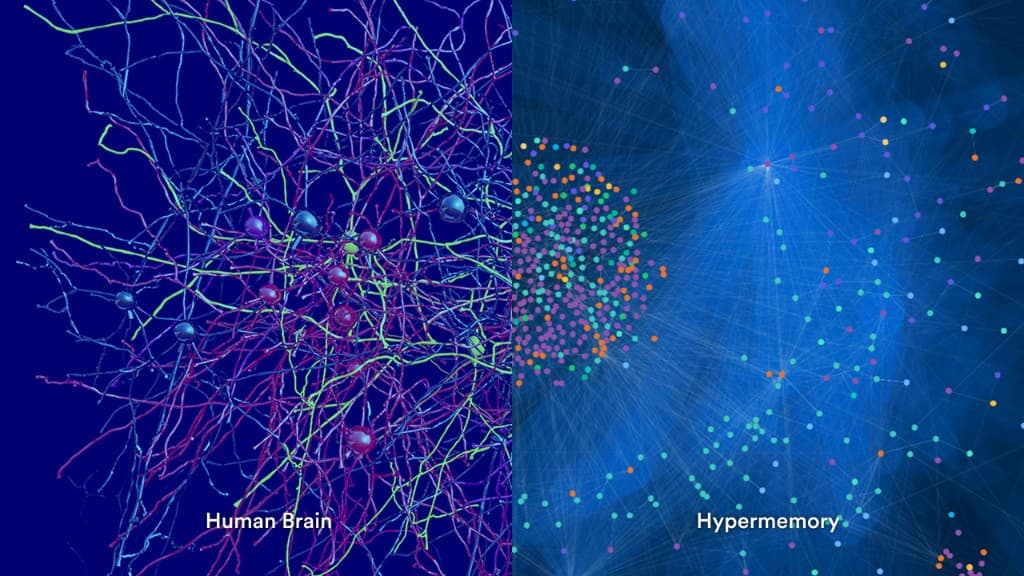
Human recall rarely works like a spreadsheet row. Hypergraphs mirror how associations actually fire.

When you remember a meeting, you do not fetch five isolated facts in sequence. People, place, outcome, and timing come back together because they were encoded as one episode.

Side-by-side comparison of a human brain neural network and a Hypermemory hypergraph network

Hypermemory works the same way. A hyperedge preserves that episode: who was involved, what it concerned, when it happened, and what was decided, without forcing your agent to rebuild the scene edge by edge.

That is why dense hypergraph memory feels more natural in long-running work. Agents recall context the way you do: by reactivating a connected cluster, not by hunting through unrelated pairwise links.

See the difference a hypergraph makes.

3,000 queries and 3,000 nodes per month. Free forever. No credit card.